Risk

In this episode of High Theory, Faye Raquel Gleisser tells us about Risk. A calculable danger in economics, athletics, sociology, or healthcare, risk has become a socially constructed danger that changes who we are and how we move through the world. Faye asks us to think about how risk management and risk literacy shaped the conceptual and performance work of American artists in the late twentieth century. Who is at risk? Who is safe? And how do we know?

Faye’s book, Risk Work: Making Art and Guerrilla Tactics in Punitive America, 1967–1987 (U Chicago Press, 2023) studies how artists in the US starting in the 1960s came to use guerrilla tactics in performance and conceptual art, maneuvering policing, racism, and surveillance.

As US news covered anticolonialist resistance abroad and urban rebellions at home, and as politicians mobilized the perceived threat of “guerrilla warfare” to justify increased police presence nationwide, artists across the country began adopting guerrilla tactics in performance and conceptual art. Risk Work tells the story of how artists’ experimentation with physical and psychological interference from the late 1960s through the late 1980s reveals the complex and enduring relationship between contemporary art, state power, and policing. Drawing on art history and sociology as well as performance, prison, and Black studies, Gleisser argues that artists’ anticipation of state-sanctioned violence invokes the concept of “punitive literacy,” a collectively formed understanding of how to protect oneself and others in a carceral society.

Faye Raquel Gleisser is an associate professor of art history at Indiana University and curator, whose work focuses on three main subject areas: art and tactical intervention; the racial logics of archives; and curatorial ethics and canon formation. By bridging curation, art history, and performance studies, she investigates histories of art that challenge intertwined anti-Black societal structures and patriarchal, white-centering notions of value that have long limited the canon of “American art.” She approaches art as a material manifestation of sociopolitical conditions and artists as theorists of power and social encounter.

In the episode Faye names several artists including Asco, Chris Burden, the Guerrilla Girls, Tehching Hsieh, and Adrian Piper. This image for this episode is a photograph by Harry Gambota Jr. titled First Supper (After a Major Riot), 1974 that documents a performance by the Chicano art group Asco in Los Angeles. See the Artsy page about the photograph for more about the art and the artist.

Non-Literary Fiction

In this episode of High Theory, Esther Gabara talks with us about Non-Literary Fiction, that is, works of fiction that belong to the world of contemporary art, rather than the world of contemporary literature. She focuses on literary and narrative strategies used by Latin American and Indigenous American artists to make “non-objective” forms of visual art under the pressures of neoliberalism. To learn more, check out her book, Non-Literary Fiction: Art of the Americas under Neoliberalism (Chicago University Press, 2022).

In our conversation, Esther gave us a theoretical bibliography of thinkers from Latin America who have shaped her work on non-literary fiction. Prominent among these figures are Ferreira Gullar in Brazil and Juan Acha in Mexico, who were the founding thinkers of the term “Non-Objectualism”– a term that informs the fiction making practices Esther studies. We found this cool piece on Juan Acha that might be worth reading. She also named the philosopher Rodolfo Kusch and his work with indigenous storytellers. Kusch’s book on Indigenous and Popular Thinking in América was translated into English and published by Duke in 2010. And finally she named the indigenous artist and activist Manuel Quintín Lame, who collaborated with the Columbia artist Antonio Caro. Each of these figures features in her book as a theorist in their own right, in a context where art is a critical practice.

Esther Gabara is a professor of Romance Studies at Duke University, where she works with modern and contemporary art, literature, and critical theory from the Americas. Her teaching in the departments of Romance Studies and Art, Art History & Visual Studies at Duke University covers visual studies, modernism, photography, Pop Art and popular culture, feminism, public art, and coloniality in contemporary art. Her prior publications include the bilingual exhibition catalogue, Pop América, 1965-1975 (Nasher Museum of Art/Duke University Press, 2018), for an exhibition she curated at the Nasher Museum of Art, and Errant Modernism: The Ethos of Photography in Mexico and Brazil (Duke University Press, 2008).

Ghosts In Our Fields

High Theory Halloween 2024

High Theory returns with a series of haunting concepts, places, and figures from our former guests. We asked folks to call in with something spookworthy (neologism!) from their fields – real or imagined specters, scary ideas, anything that can haunt, disorient, unsettle, horrify. And we got a full seance worth of ghosts. Listen if you dare! 

This episode features (in order of appearance)

Abhishek Avtans on the Churail. He kindly gave us a transcript (we hope to have more transcripts soon!). You can hear more from Abhishek in his episode on Apabhraṃśa. 

Angelina Eimannsberger on the Reader. You can hear more from Angelina in her episode on JVN. 

Travis Chi Wing Lau on Mad Studies. You can hear more from Travis in his episode on Experimental Life. 

Mackenzie Cooley on the Scientific Revolution. You can hear more from Mackenzie in her episode on the Animal. 

Farah Bakaari on the Nation State. You can hear more from Farah in her episode on the Trace. 

Emma Heany on Communism and Empire. You can hear more from Emma in her episode on Sexual Difference. 

Sheila Liming on Nowhere and Forever. Sheila reads an excerpt from her article in progress on the contemporary gothic, under the working title, “Out of Time: Anti-Immediacy in Mark Jenkin’s Enys Men.” You can hear more from Sheila in her episode on the Party. 

Sritama Chatterjee on Nature and Wilderness. You can hear more from Sritama in her episode on Off-Shore Aesthetics. 

John Linstrom on Liberty Hyde Bailey’s Haunted Houses. You can hear more from John in his episodes on Nature Study and Ecosphere.

The image for this episode features creepy red creatures on a dark green background. It was made by Saronik Bosu. 

Boo!

Inhuman

In this episode of High Theory, Rasheed Tazudeen tells us about the inhuman. The inhuman offers a way of moving beyond the legacies of humanism and across categories and scales of being. Thinking with the inhuman world, from spools of thread to microplastics, helps us try and think otherwise about the complex assemblages that shape our lives. 

If you want to learn more, check out Rasheed’s new book, Modernism’s Inhuman Worlds (Cornell UP, 2024). The book explores the centrality of ecological precarity, species indeterminacy, planetary change, and the specter of extinction to modernist and contemporary metamodernist literatures. Modernist ecologies emerge in response to the enigma of how to imagine inhuman being—including soils, forests, oceans, and the earth itself—through languages and epistemologies that have only ever been humanist. Rasheed asks how (meta)modernist aesthetics might help us to imagine (with) inhuman worlds, including the worlds still to be made on the other side of mass extinction. 

Rasheed Tazudeen is a lecturer in English at Yale University. His work is focused broadly on the intersections between ecology, race, and sound in 19th- and 20th-century literature and music. He is currently at work on a second project tentatively titled The Musicked Earth: Towards a Decolonial Sound Ecology, focused on the resonances between Black/Afro-Caribbean and Indigenous theories of sound, music, festival, and ecology through the work of Sylvia Wynter, Édouard Glissant, Leanne Simpson, and Alice Coltrane. 

This week’s image was made by Saronik Bosu in 2024. It represents a humanoid creature in fetal position, merging with the inhuman world.

Tagged : / / /

Animal

In this episode of High Theory, Mackenzie Cooley talks about animals. The animal lies at the center of science and the human, from imperial conquest and Enlightenment thought to the creatures on our dinner plates and sitting beside us at the table. The practices of animal breeding and the politics of making life are, in Mackenzie’s account, key to understanding the history of race, as a concept that emerged in the Early Modern World.

For more animal encounters, check out her book The Perfection of Nature: Animals, Breeding, and Race in the Renaissance (Chicago UP, 2022). In it, Italian horses and Mexican dogs provide examples of controlled breeding before eugenics, help us understand how human difference was understood in the colonial encounter, and illuminate undertheorized notions of generation and its discontents in the more-than-human world. 

Tag dog and Bartolomé the cat sometimes participate in the making of High Theory, but the podcast is not necessarily pitched to non-human ears. If you want radio for animals, listen to Bad Animals on WFMU. 

Mackenzie Cooley is Assistant Professor of History, Director of Latin American Studies at Hamilton College. She is an intellectual historian who studies the uses, abuses, and understandings of the natural world in early modern science and medicine. And she has two Newfoundland dogs. 

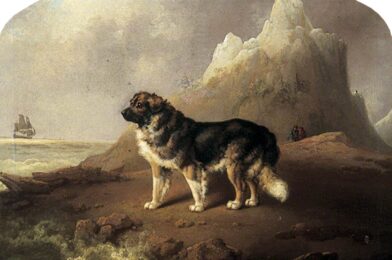
The image accompanying this episode is a painting of a Newfoundland Dog by Charles Henry Schwanfelder (1812), from the collection of Temple Newsam House, Leeds Museums and Galleries. 

Tagged : / / / / /

Melodrama

We often misuse the word melodrama with abandon, especially to characterize other people’s behaviors, but Greg Vargo defines it for us once and for all. Emerging in the eighteenth and nineteenth centuries as the predominant Western theatrical form, it is a genre of crisis. To that end, it employed hyperbolic language, extreme situations, extraordinary coincidences, stark oppositions and so on. Greg talks about his own ongoing work on melodramas about race, their histories of performance, and the storied career of the African American actor Ira Aldridge.

Greg Vargo is Associate Professor at the Department of English, New York University. His research focuses on the literary and cultural milieu of nineteenth-century British protest movements and the interplay between politics, periodical culture, the novel and theater. His first book, An Underground History of Early Victorian Fiction: Chartism, Radical Print Culture, and the Social Problem Novel (Cambridge UP, 2018), won the 2019 North American Victorian Studies Association’s award for best book of the year in Victorian Studies. He has recently edited Chartist Drama (Manchester UP, 2020), a collection of four plays written or performed by members of the working-class movement for social and political rights known as Chartism. A new project focuses on anti-imperialism in nineteenth-century popular culture (across such media as penny novels and stage melodrama) as well as in radical politics.

Image: © 2024 Saronik Bosu

Tagged : / / / / / / /

Close Reading

In this episode of High Theory, Jonathan Kramnick talks about Close Reading. Contrary to the name, it is less a form of slow or focused reading than an immersive practice of writing. The classic methodology of New Criticism has become, in Kramnick’s estimation, the shared foundation of literary studies in the university.

Our conversation was inspired by Jonathan’s new book, Criticism and Truth: On Method in Literary Studies (Chicago, 2023). In the book he aims to “present a view of literary criticism as it is practiced across the academy in order to defend its standing as a contribution to knowledge” (vii). His defense of this foundational critical method joins a slate of recent metacritical books on the discipline of literary study, and the state of the humanities today.

Jonathan Kramnick is the Maynard Mack Professor of English at Yale University. His research and teaching are in eighteenth-century literature and philosophy, foundations of literary theory and criticism, and interdisciplinary approaches to the arts. His prior publications include Paper Minds: Literature and the Ecology of Consciousness (Chicago, 2018), Actions and Objects from Hobbes to Richardson (Stanford, 2010), and Making the English Canon: Print Capitalism and the Cultural Past, 1700-1770 (Cambridge, 1999). His current book project on Alexander Pope, William Cowper, and the poetics of designed environments is titled Earthworks: Two Before Romanticism. He is also director of the Lewis Walpole Library and the editor (with Steven Pincus) of the Lewis Walpole Series in Eighteenth-Century Culture and History for Yale University Press.

The image accompanying this episode was drawn by Saronik Bosu in 2024.

Criticism

In this episode of High Theory, Matt Seybold tells us about Criticism, the glue that holds the bricks of culture together. Cultural critics are a necessary component of the intellectual ecosystem, who have the power to analyze both the material conditions and the myths that make up our world. 

Matt is the host of the American Vandal Podcast at the Center for Mark Twain Studies at Elmira College. In his recent podcast series, Criticism, LTD, Matt investigated the state of criticism in the academy and the public sphere. There is a nifty substack newsletter with the transcripts from Criticism, LTD, if you’re keen. Kim and Saronik were among the many podcasters, public intellectuals, and critics that Matt interviewed for the series, and we’re excited to have him back on High Theory to tell us about his investigations. 

In the episode he offers a recuperative reading of Mark Twain’s acerbic take on critics in his late notebooks: “The critic’s symbol should be the tumble-bug; he deposits his egg in somebody else’s dung, otherwise he could not hatch it.” (see p. 392 of this Harper & Brothers, 1935 edition of Twain’s Collected Works, on archive.org). He references Jacques Derrida’s book, Limited Inc (Northwestern UP, 1988), which contains the *famous* essay “Signature, Event, Context” and a critical debate about Apartheid. And he also discusses Jed Esty’s Future of Decline: Anglo-American Culture at Its Limits (Stanford UP, 2022) and our episode with Jed on the Rhetoric of Decline. You can also take a listen back to Matt’s earlier episode with us on  Economics. 

Matt Seybold is Associate Professor of American Literature & Mark Twain Studies at Elmira College, as well as Resident Scholar at the Center For Mark Twain Studies. He is the executive producer and host of the American Vandal Podcast, and founding editor of MarkTwainStudies.org. He is co-editor (with Michelle Chihara) of of the Routledge Companion to Literature & Economics (2018)and (with Gordon Hutner) a 2019 special issue of American Literary History on “Economics & Literary Studies in The New Gilded Age.” Recent articles can be found in the Mark Twain Annual, American Studies, Reception, and Los Angeles Review of Books. He tweets (or exes?) @MEASeybold. 

The image for this episode was made by Saronik Bosu in 2024.

Tagged : / / / / /

Teaching

In this special episode of High Theory, Ramsés Martínez Barquero and Abigail Cowan interview their graduate student colleagues about teaching. They turn our attention to graduate study as one of the foundational aspects in building academic knowledge, and show us graduate instructors encountering the classroom as a learning environment for teachers and students. Abigail and Ramses recorded interviews with eight fellow graduate students in a story circle they held at the PennState Humanities Institute as part of their Public Humanities Fellowship program. The episode weaves together stories of anxiety and humor, pushing against self doubt, and finding community while pursuing graduate studies.

Ramsés Martínez Barquero is a M.A/PhD student in the Department of Spanish, Italian and Portuguese. He earned a BA in Spanish Philology in Barcelona, where he was born and raised. While  at Universitat Autònoma de Barcelona, Ramsés collaborated with GEXEL (Grupo de Estudios del Exilio Literario), a group that focuses on the Spanish Republican Exile, which took place after the Spanish Civil War (1936-1939). His interests and research projects focus on the republican exile, such as Max Aub’s and Antonio Buero Vallejo’s epistles, almost unknown authors like Álvaro de Orriols, and the communication between the exiled authors and the ones who lived inside Spain during Franco’s dictatorship. Ramsés is also interested in contemporary theater and authors such as Juan Mayorga. Overall, Ramsés investigates Spanish Republican Exile along with XXth and XXIth century Spanish literature, focusing on exile, literature during the dictatorship and cultural studies that focus on topics such as cultural memory or historical memory in Spain and Europe.

Abigail Cowan is a graduate student for the Department of English and a teaching assistant for English and Comparative Literature. She is experienced in teaching Rhetoric and Composition, Human Rights and World Literature, and Technical Writing. Her inclusive and collaborative pedagogical approach emboldens students to advocate for their learning needs and seize their passions. Abigail earned her Bachelor’s degrees in English Literature and Creative Writing from Western Michigan University. Her current research interests include women’s, gender, and sexuality studies, Marxist feminism, speculative fiction, and digital humanities. In her free time, she enjoys creative writing, singing, reading, and cuddling her cat, Omar.

Kristina Bowers is a PhD student at Penn State University studying Rhetoric and Composition and Women’s, Gender, and Sexuality Studies. Their research interests include queer/trans, feminist, and embodied rhetorics; digital humanities methods; Writing Program Administration; and editing. They hold a Masters of Arts in English and a Master of Arts in Teaching K-12 English as a Second or Other Language as well as a BA in English/Women’s and Gender Studies. They have experience teaching EL students at a K-5 school, consulting and program coordination in a university Writing Center, and editing professional and academic materials. In their free time, Kristina enjoys hiking and cooking with their wife.

Vani Gupta is a doctoral student in the HDFS Department at Penn State University. With research experience at the Decision Lab in IIT Kanpur, she focused on studying the impact of Covid-19 on anxiety and foraging decisions. Vani holds a Master’s degree in Biological Sciences and Bio-engineering from IIT Kanpur and a Bachelor’s degree in Biotechnology from Delhi Technological University. Her research interests include neuroscience of mindfulness and empathy through decision making, across different developmental periods. In her free time, she enjoys singing Hindustani classical music, learning Sanskrit, and volunteering. Vani also loves traveling and engaging in interesting conversations with ‘humans’ across the world.

Ash Mayes is a master’s student in the English department. Her studies center rhetoric and composition studies with particular emphasis on digital multimodal composition. She is interested in studies of labor, food, and technology. Additionally, Ash teaches rhetoric and composition and technical writing courses to undergraduate students. Her pedagogy takes a universal design approach to build upon and expand the multiple and intersecting literacies, skills, and perspectives that students come into the classroom already possessing.

Ana Sofía Semo is a second-year graduate student in the Department of Spanish, Italian and Portuguese, and now she teaches Spanish 2 in the Spanish Basic Language Program. She obtained her B.A. in Social Communication on which she specialized in film language. Her undergraduate dissertation was on the representation of sexuality and eroticism in the Mexican Golden Age Cinema. She also studied Semiotics and History of Ideas at the National University of Entre Ríos in Argentina. Moreover, she worked as a soft news reporter for Reforma newspaper in Mexico City and in the communications area of an NGO. Her current research interests include the representation of Jewish women in contemporary Latin American literature, Jewish studies and Gender and Women studies. In her free time, Ana Sofía loves discovering new places on her bike and cooking.

María José Andrade Gabiño is a Ph.D. student in the Spanish, Italian, and Portuguese Department. She holds a BA in literature from the Universidad de las Américas Puebla (UDLAP) with an honors thesis about masculinity constructions in the Ateneo de la Juventud, a group of young writers at the early twentieth-century who became essential figures in the configuration of post-revolutionary Mexico. She has worked as a journalist in LADO B, an independent digital newspaper in Puebla, Mexico. Her journalistic investigations have been around cultural production, feminism, LGBT+ community and the current situation of violence against women in Mexico.

Alex Mika is a second-year PhD student in the Penn State English Department studying Shakespeare’s cultural legacy via literary, cinematic, and dramatic adaptations of his works. He is especially interested in exploring the ways in which Russian literary and dramatic figures have engaged with Shakespeare’s plays. He also enjoys learning languages, playing the piano, and occasionally falling down rabbit holes. 

The image for this episode was made by Saronik Bosu in 2023. 

Tagged : / /

Plot

In this episode of High Theory, Pardis Dabashi tells us about plot. A plot consists of a change with stakes that establish norms. This seemingly simple structure shapes novels, films, politics, and our world, from easy seductions of comfort to difficult promises of liberation.

In the episode, Pardis references Thomas Edison’s 1903 film, Electrocuting an Elephant, which is super sad, and kind of terrifying, but an economical explanation of plot. She also discusses Max Ophüls’s 1953 film, The Earrings of Madame de… as an example of a film with a potentially liberatory plot. We recommend you watch the latter, not the former. Other texts referenced in this episode include Mary Anne Doane’s The Emergence of Cinematic Time (Harvard, 2002) and Lauren Berlant’s Cruel Optimism (Duke, 2011) and Female Complaint (Duke, 2008).

The occasion for our conversation was Pardis’s new book, Losing the Plot: Film and Feeling in the Modern Novel (U Chicago Press, 2023). If you’d like to get yourself a copy there’s a 30% discount on the University of Chicago Press website with the promo code UCPNEW. It’s a book about film and literary modernism, including the work of Nella Larsen, Djuna Barnes, and William Faulkner. The cover is really beautiful, and it’s definitely worth a read if you’re interested in either of the genres it addresses.

Pardis Dabashi is an Assistant Professor of Literatures in English and Film Studies at Bryn Mawr College, where she is also Affiliated Faculty in the Middle Eastern, Central Asian, and North African Studies Program (MECANA). She has published everywhere, and is friends with everyone! She teaches courses in twentieth-century literature, film studies, Middle East studies, and theory. She was also one of the first guests on High Theory! You can listen to her 2020 episode on The Autonomous Work of Art if you’re feeling a flashback.

The image for this episode is a publicity still from George Cukor’s 1936 MGM film Camille, showing Greta Garbo and Robert Taylor in a tense embrace. Digital image from Wikimedia Commons.

Tagged : / / /
css.php